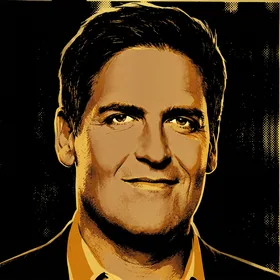
Ref. 256 · versus · Power reserve 4 min
Oprah Winfrey vs. Mark Cuban: Leading from the Inside Out vs. Winning from the Outside In


What drives business success — cultivating your inner life and values, or treating the competitive arena as an all-consuming sport you play to win? Oprah Winfrey and Mark Cuban have both built billion-dollar empires, but they start from completely different places when answering that question.
Oprah Winfrey: Purpose as the Engine
Oprah’s entire business philosophy flows from an internal source. Connection, gratitude, clarity, and power are not soft concepts for her — they are the architecture of every decision she has made. The question that stopped her cold during a 1998 interview with film critic Gene Siskel — “What do you know for sure?” — became the organizing principle of her work for decades. She didn’t know the answer in the moment. But the fact that she couldn’t answer it drove her to keep asking.
“I make sure to use my life for goodwill. Because I know for sure that what I think, what I say, what I do — everything will be returned to me.”
— Oprah Winfrey, What I Know for Sure
This isn’t just a spiritual posture. For Oprah, it’s a business strategy. Her audiences trusted her because they felt she was operating from a place of genuine values rather than competitive calculation. That trust became the currency that funded every venture she launched — from her talk show dominance to the OWN network to her book club’s extraordinary commercial power. She built an empire by turning inward first, and letting the outward results follow. The source material she draws from is relational and emotional: “You have to tell the story so that people feel something. They only want to do something after they feel something.” Feeling precedes action. Interior before exterior.
Mark Cuban: The Game Never Stops
Cuban’s frame could not be more different. Where Oprah looks inward for direction, Cuban looks outward at the competitive landscape — and sees a battlefield with no timeouts. Business, for him, is not a vehicle for self-expression or purpose. It is the ultimate sport, and the only acceptable outcome is winning.
“The sport of business is the ultimate competition. It’s 7 x 24 x 365 x forever. I love the sport of business. I love the competition. I love the fire of it. It’s the feeling of the clock winding down, the ball in your hands, and if you hit the shot you win…. all day, every day. Relaxing is for the other guy.”
— Mark Cuban, How to Win at the Sport of Business
Cuban built his fortune through relentless competitive awareness — reading faster, preparing harder, and staying locked in when others checked out. His approach demands constant vigilance: he describes sitting in front of the TV not to watch it, but to mine it for anything useful to his business. There is no off switch. The fire is the fuel. Where Oprah finds clarity through reflection and gratitude, Cuban finds his edge through perpetual motion and an almost adversarial relationship with complacency. His framework is external, tactical, and urgent — and it turned a kid from Pittsburgh into a billionaire before he was forty.
The Tension
Both approaches work. That’s the uncomfortable truth, and it’s worth sitting with. Cuban’s model thrives in high-velocity, competitive markets — tech, trading, early-stage startups — where the window closes fast and hesitation is fatal. When the clock is winding down, inner peace is not the variable that wins the game. Preparation, aggression, and competitive intelligence are. His 7x24x365 mentality is not a personality quirk; it’s a legitimate edge in environments that punish the distracted.
But Oprah’s model unlocks something Cuban’s framework can’t easily manufacture: deep, durable trust at scale. The brands and movements she built weren’t won through competitive maneuvering — they were earned through a consistency of values that audiences could feel. In businesses where the product is a relationship, where loyalty is the moat, and where the founder is the brand, operating from a place of genuine inner conviction isn’t soft strategy. It’s the only strategy that compounds over time. The tension here isn’t really internal versus external — it’s about which competitive environment you’re operating in, and what kind of empire you’re trying to build.
The Memo
-
Identify which game you’re actually playing. Cuban’s all-in competitive intensity is an asset in fast-moving, zero-sum markets. Oprah’s values-first approach pays off when trust and emotional resonance are your primary product. Importing the wrong model into the wrong environment is a costly mistake.
-
Know what you know for sure — and let it guide your positioning. Oprah’s brand power came from radical clarity about her own values. Before you compete, get honest about what you stand for. That clarity becomes a filter for every decision you make.
-
Treat preparation as non-negotiable, whatever your style. Cuban reads everything, watches everything, and converts idle time into competitive intelligence. Oprah studies human emotion and storytelling with the same intensity. The medium differs; the discipline doesn’t.
-
Audit whether your drive is sustainable. Cuban’s “relaxing is for the other guy” mindset is a rocket engine — extraordinary for acceleration, potentially destructive over decades. Oprah’s framework is designed for longevity. Build the intensity you need to win, then build the foundation that keeps you in the game.