Ref. 235 · versus · Power reserve 5 min
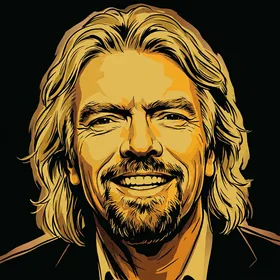
Richard Branson vs. Sam Zell: Leap First vs. Look Hard


Should you move fast and trust your instincts, or slow down and interrogate every assumption before committing? Richard Branson and Sam Zell have both built empires — but they got there by answering that question in fundamentally different ways. One treats the first step as the most important act in business. The other built his fortune by refusing to take that step until the odds were stacked in his favor.
Richard Branson: At Least I Tried
“I never think that I am going to die by accident, but if I were to die then all I can say is that I was wrong, and the hardened realists who kept their feet on the ground were right. But at least I tried.”
— Richard Branson, Losing My Virginity, ch. You go ahead with this over my dead body
Branson’s philosophy of action was forged early. Dropped out of school at sixteen, launched a student magazine with no publishing experience, then built a record shop, a record label, an airline, and eventually a space tourism company — each venture born from the same restless conviction that starting matters more than preparing. His parents, by his own account, gave him room to fail spectacularly and learn from it. That upbringing hardwired a bias toward motion over deliberation.
What makes Branson’s approach more than recklessness is the framing: he isn’t arguing against thinking — he’s arguing against paralysis. The enemy, in his view, is the mental habit of projecting every possible obstacle before you’ve taken any action at all. He treats momentum itself as a form of intelligence. Get moving, gather real information, adjust. For Branson, the brand of Virgin was built not on careful market research but on a repeated willingness to enter industries — airlines, mobile, finance, space — where conventional wisdom said he had no business competing.
Sam Zell: Survive First, Win Second
“Am I being too subtle?”
— Sam Zell, Am I Being Too Subtle?
That question — the title of Zell’s book and his unofficial motto — captures his entire operating philosophy. Zell made his billions in real estate and private equity by being contrarian in a very specific way: not contrarian for its own sake, but contrarian because he had done the work to see what others missed or chose to ignore. Known as the “Grave Dancer” for buying distressed assets when everyone else was fleeing, Zell’s edge was never boldness alone. It was disciplined, almost obsessive, clarity about risk and downside before a single dollar moved.
Where Branson sees hesitation as the enemy, Zell treats unexamined enthusiasm as the real danger. His career was built on asking the hard questions out loud — even when, especially when, the room didn’t want to hear them. The title of his book isn’t ironic; it’s a genuine reflection of his style. He was often the person in the room stating what others danced around. That directness extended to how he evaluated deals: if you couldn’t explain precisely why the downside was survivable, you didn’t do the deal. Zell’s version of the first step was to map the last step — to understand the exit and the worst case before committing to the entry.
The Tension
These aren’t just personality differences — they reflect genuinely different theories about where business risk actually lives. Branson’s model assumes that the cost of inaction is usually higher than the cost of a stumble. In fast-moving consumer markets, where brand and timing are decisive, he’s often right. The window for Virgin Atlantic wasn’t going to stay open while Branson ran the numbers for three more years. Speed and audacity were the competitive advantage. His mother’s letters, quoted in the book, confirm that even his childhood failures were treated as tuition — which meant failure was never truly catastrophic. The system around him was built to absorb it.
Zell operated in markets — distressed real estate, leveraged buyouts, cyclical industries — where timing and price discipline are everything and where a single misjudged deal can wipe out years of gains. In those environments, the people who moved fast and trusted their gut often became the distressed assets that someone like Zell would later buy at a discount. His contrarianism wasn’t about going slow for its own sake; it was about preserving the right to act decisively when the conditions were genuinely right. The courage Zell valued wasn’t the courage to leap — it was the courage to say what nobody else in the room was willing to say, including “this deal doesn’t work.”
The Memo
-
Match your risk posture to your market. Branson’s bias toward action works in brand-driven, consumer-facing markets where momentum is a moat. Zell’s demand for downside clarity works in capital-intensive, cyclical markets where one bad position can be terminal. Know which game you’re playing before you decide how fast to move.
-
Define what failure costs you before you define what success looks like. Branson could afford to fail repeatedly because each venture was somewhat ring-fenced from the others. If your failures aren’t survivable, Zell’s instinct to stress-test the worst case first isn’t timidity — it’s discipline.
-
Use the first step as information, not as commitment. Branson’s point isn’t that you should bet everything immediately — it’s that action generates real data that planning cannot. Take the smallest viable step that gives you genuine feedback, then decide how far to go.
-
Ask the uncomfortable question out loud. Zell’s greatest competitive advantage wasn’t his balance sheet — it was his willingness to state what others left unsaid. Whatever your risk appetite, build the habit of naming the most obvious reason a plan could fail before you’ve fully committed to it.