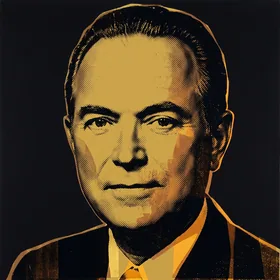
Ref. 88 · versus · Power reserve 4 min
Warren Buffett vs. Ray Kroc: Waiting for the Perfect Pitch vs. Grinding Through the Miss


When markets turned against Warren Buffett in 1999, he didn’t chase the trend. When Ray Kroc was grinding through failed ventures well into his fifties, he didn’t stop swinging. Both built empires — but their philosophies on patience, discipline, and when to act could hardly be more different.
Warren Buffett: Sit on Your Hands Until the Odds Are in Your Favor
“We had the worst absolute performance of my tenure and, compared to the S&P, the worst relative performance as well.”
— Warren Buffett, Berkshire Shareholder Letter 1999
In 1999, the dot-com bubble was inflating at warp speed. Yahoo! had quadrupled in value. Berkshire Hathaway stock had stumbled badly enough that Barron’s ran a cover story asking “Warren, What’s Wrong?” Buffett’s personal ranking on wealth lists had slipped. Technophiles declared his approach obsolete. And yet Buffett refused to buy into the mania. He acknowledged the poor results openly — with characteristic self-deprecation — and held his ground.
That discipline is the core of Buffett’s investment philosophy. He famously described investing as a game where you don’t have to swing at every pitch. The strike zone is wide, the pressure to act is constant, but the great investor’s edge comes from waiting — sometimes for years — until the fundamentals justify the price. In 1999, nothing about internet stocks justified their valuations by his standards. So he watched, took the criticism publicly, and stayed patient. Within two years, the Nasdaq had collapsed by nearly 80%. Buffett’s reputation, and his portfolio, rebounded. His willingness to look wrong in the short term in order to be right in the long term is the defining feature of his approach.
Ray Kroc: Keep Grinding Until Something Breaks Your Way
“I was 52 years old. I had diabetes and incipient arthritis. I had lost my gall bladder and most of my thyroid gland in earlier campaigns. But I was convinced that the best was ahead of me.”
— Ray Kroc, Grinding It Out
Ray Kroc spent decades as a paper cup salesman and milkshake machine distributor before he walked into a McDonald’s restaurant in San Bernardino in 1954 and saw something nobody else saw: a system that could be replicated everywhere. He wasn’t waiting for the perfect moment. He was moving constantly — selling, pitching, experimenting — and the opportunity found him mid-grind. Where Buffett prized stillness and selectivity, Kroc prized relentless forward motion.
Kroc’s genius wasn’t in identifying an obvious winner from a distance. It was in recognizing potential through direct, lived experience — and then having the energy and stubbornness to act on it when most men his age were winding down. He didn’t build McDonald’s into a global empire by waiting for conditions to be ideal. He built it by obsessing over every detail of the operation — the fry temperature, the bun size, the speed of service — and refusing to accept that good enough was good enough. His discipline wasn’t about restraint. It was about consistency of effort, day after day, through the failures and the physical setbacks and the financial strain.
The Tension
The honest question this contrast raises is: what kind of game are you actually playing? Buffett operates in public markets, where information is abundant, prices fluctuate daily, and the temptation to act is relentless. His discipline is a defense against that noise. The value of his patience is precisely that it’s rare — most investors can’t hold still while peers are getting rich on momentum trades. His edge comes from knowing what he won’t do.
Kroc was playing a different game entirely. He was an operator in a world where insights don’t come from reading balance sheets — they come from being in the room, watching the kitchen, talking to the customers. Waiting, for Kroc, would have meant missing the moment. The McDonald’s brothers weren’t going to hold the opportunity open indefinitely. His competitive advantage wasn’t analytical patience; it was experiential hunger. Both men were disciplined, but they channeled that discipline in opposite directions: one into restraint, one into relentless execution. The mistake would be applying Buffett’s framework to Kroc’s situation, or vice versa.
The Memo
-
Match your discipline to your domain. Buffett’s patience works in markets where time is your ally. Kroc’s relentlessness works in operations where momentum compounds. Know which game you’re in before you decide whether to wait or move.
-
Hold your ground when the crowd turns against you — but only if your reasoning, not just your stubbornness, still holds. Buffett stayed out of dot-com stocks because the fundamentals didn’t change. That’s conviction. Ignoring new evidence is something else entirely.
-
Stay in motion long enough for opportunity to find you. Kroc’s breakthrough at fifty-two didn’t come from a strategic plan. It came from decades of showing up. The grinding itself created the conditions for the insight.
-
Acknowledge bad results without abandoning your principles. Buffett’s 1999 letter didn’t spin the numbers or deflect blame. He called it plainly and explained his reasoning. That transparency — paired with long-term consistency — is its own form of competitive advantage.
Correction, 29 September 2026: an earlier version of this memo quoted Buffett’s 1999 letter with a final sentence about Inspector Clouseau that we cannot verify against the letter’s text. The quote now stops where the verified text does, and the prose that relied on that sentence has been rewritten.
Correction, 30 September 2026: an earlier version quoted this passage in altered wording. It now matches the book word for word.