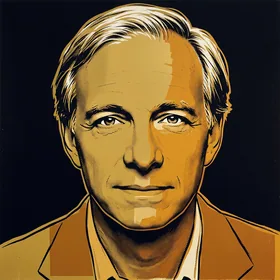
Principles is not really a memoir, and reading it as one is why people bounce off it. The life story occupies a short opening section. The remaining two-thirds is an operating manual, written as numbered rules, for how to make decisions when you already know you are unreliable.
What the book actually argues
Dalio’s premise is that the main obstacle to good outcomes is not the market, competitors, or luck. It is that you cannot see your own blind spots, and neither can anyone else see theirs:
“Don’t confuse what you wish were true with what’s really true. Don’t worry about looking good — worry instead about achieving your goals.”
— Ray Dalio, Principles: Life and Work, ch. Embrace Reality and Deal with It
Everything downstream is machinery for catching that. Radical transparency is not a values statement in this book; it is a debugging tool:
“Being radically truthful and transparent with your colleagues and expecting your colleagues to be the same with you ensures that important issues are apparent instead of hidden. It also enforces good behavior and good thinking, because when you have to explain yourself, everyone can openly assess the merits of your logic.”
— Ray Dalio, Principles: Life and Work, ch. Trust in Radical Truth and Radical Transparency
The idea most worth stealing
Most organisations resolve disagreement by seniority or by vote. Dalio proposes a third option — weight opinions by demonstrated track record on that specific kind of question:
“When believability weighting is done correctly and consistently, it is the fairest and the most effective decision-making system. … But for this to be the case, the criteria for establishing believability must be objective and trusted by everybody.”
— Ray Dalio, Principles: Life and Work, ch. Believability Weight Your Decision Making
Note the conditional in the second sentence. Dalio states the load-bearing requirement plainly, and it is the part most readers skip: the system only works if everyone trusts how believability is scored. That is a much harder problem than the voting mechanism it enables.
On pain, which is the book’s most-quoted idea and its most misquoted
The formula is short enough to survive being reduced to a poster, so it usually is:
“Pain + Reflection = Progress. There is no avoiding pain, especially if you’re going after ambitious goals. Believe it or not, you are lucky to feel that kind of pain if you approach it correctly, because it is a signal that you need to find solutions so you can progress.”
— Ray Dalio, Principles: Life and Work, ch. Embrace Reality and Deal with It
The qualifier — if you approach it correctly — is doing all the work and is almost always dropped. Dalio is not claiming pain is good. He is claiming pain is information, and that most people waste it by reacting rather than reflecting.
He is also blunt that you are frequently not the right person to decide your own case:
“You shouldn’t assume that you are always the best person to make decisions for yourself because often you aren’t. While it is up to us to know what we want, others may know how to get it better than we do.”
— Ray Dalio, Principles: Life and Work, ch. Embrace Reality and Deal with It
Where to be sceptical
Two things the book underweights rather than hides.
The culture is not universally survivable. Bridgewater’s radical transparency has been widely reported as punishing for capable people who do well elsewhere. Dalio’s answer — that such people are not suited to an idea meritocracy — is available to him only because he owns the firm. It is not available to a reader trying to import the system into a company where leaving is costly.
Believability is more circular than it looks. Opinions are weighted by track record; track record is scored by the system; the system was designed by the person with the highest score. Dalio addresses the mechanics of measurement in detail and the circularity barely at all.
Neither invalidates the book. Both are worth holding while reading a text this confident about its own machinery.
The structure, and why “Principles chapter 3” is ambiguous
Principles is three books bound together, and the chapter numbering restarts twice. That is worth knowing before you look anything up.
- Where I’m Coming From — the memoir, chapters 1–8, each a dated span of his life
- Life Principles — five numbered chapters
- Work Principles — sixteen numbered chapters
So the book contains a “Chapter 1” three times over: My Call to Adventure: 1949–1967, Embrace Reality and Deal with It, and Trust in Radical Truth and Radical Transparency. A reference to “Principles chapter 3” is genuinely ambiguous unless the part is named, which is why every citation on this site gives the chapter title rather than a number.
One more quirk: the summary tables sit before the section they summarise, so Work Principles is summarised in full before its introduction.
Where I’m Coming From — the memoir
| Chapter | What is in it |
|---|---|
| Introduction | Opens by disclaiming authority: he is “a ‘dumb shit’ who doesn’t know much relative to what I need to know”. |
| My Call to Adventure: 1949–1967 | Long Island, son of a jazz musician. Caddying, and his first stock purchase. |
| Crossing the Threshold: 1967–1979 | Harvard, the Merrill floor, the 1971 end of the gold standard, founding Bridgewater. |
| My Abyss: 1979–1982 | The famous collapse. He calls a depression that does not arrive, loses everything, and borrows from his father. |
| My Road of Trials: 1983–1994 | Rebuilding from one employee. Too broke to fly to a prospective client. |
| The Ultimate Boon: 1995–2010 | Forty-two employees and $4.1bn. The system starts to run without him. |
| Returning the Boon: 2011–2015 | Handing over. His three phases of life: learning, working, being free of obligation. |
| My Last Year and My Greatest Challenge: 2016–2017 | The succession that did not go smoothly. The most exposed chapter in the book. |
| Looking Back from a Higher Level | What he would tell his younger self. |
Life Principles — the five
| Chapter | The rule |
|---|---|
| 1 · Embrace Reality and Deal with It | The state of mind you bring to reality decides everything downstream. |
| 2 · Use the 5-Step Process to Get What You Want Out of Life | Goals → problems → diagnosis → design → execution. The spine of the whole book. |
| 3 · Be Radically Open-Minded | He calls this the most important chapter: ego and blind spots are the two barriers. |
| 4 · Understand That People Are Wired Very Differently | Brains differ, so every single view of reality is distorted, including yours. |
| 5 · Learn How to Make Decisions Effectively | Decision-making as a studied discipline rather than a talent. |
Work Principles — the sixteen
| Chapter | The rule |
|---|---|
| 1 · Trust in Radical Truth and Radical Transparency | With the costs stated as well as the benefits — unusual for this book. |
| 2 · Cultivate Meaningful Work and Meaningful Relationships | |
| 3 · Create a Culture in Which It Is Okay to Make Mistakes and Unacceptable Not to Learn from Them | |
| 4 · Get and Stay in Sync | |
| 5 · Believability Weight Your Decision Making | Neither autocratic nor democratic. The idea the whole firm rests on, and the one this note is most sceptical about. |
| 6 · Recognize How to Get Beyond Disagreements | |
| 7 · Remember That the WHO Is More Important than the WHAT | |
| 8 · Hire Right, Because the Penalties for Hiring Wrong Are Huge | Includes his account of Bridgewater’s own hit-or-miss early hiring. |
| 9 · Constantly Train, Test, Evaluate, and Sort People | |
| 10 · Manage as Someone Operating a Machine to Achieve a Goal | Where the machine metaphor is stated outright. |
| 11 · Perceive and Don’t Tolerate Problems | |
| 12 · Diagnose Problems to Get at Their Root Causes | |
| 13 · Design Improvements to Your Machine to Get Around Your Problems | |
| 14 · Do What You Set Out to Do | The shortest and most neglected: step five, execution. |
| 15 · Use Tools and Protocols to Shape How Work Is Done | Why written rules alone do not change behaviour. |
| 16 · And for Heaven’s Sake, Don’t Overlook Governance! | The check on everything above, and the last chapter for a reason. |
The book then closes with a conclusion and an appendix listing Bridgewater’s actual tools.
Two passages carry the argument, and they sit at opposite ends:
“Before I begin telling you what I think, I want to establish that I’m a ‘dumb shit’ who doesn’t know much relative to what I need to know.”
— Ray Dalio, Principles: Life and Work, ch. Introduction
“When you encounter problems, your objective is to specifically identify the root causes of those problems — the specific people or designs that caused them — and to see if these people or designs have a pattern of causing problems.”
— Ray Dalio, Principles: Life and Work, ch. Diagnose Problems to Get at Their Root Causes
The first is the disclaimer; the second is the method. The gap between them is the book’s real subject: a man who does not trust his own judgement building a machine so the judgement is not required.