Ref. 19 · versus · Power reserve 5 min
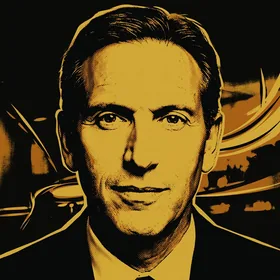
Phil Knight vs. Howard Schultz: Stumbling Forward vs. Studying Success
Can you build a billion-dollar company by winging it — or do you need to study success like a discipline before you ever get there? Phil Knight and Howard Schultz built two of the most iconic brands in American history, yet their philosophies on preparation and planning couldn’t be more different. One embraced the stumble. The other prescribed the syllabus.
Phil Knight: The Anti-Planner
“I feel sorry for the people who know exactly what they’re going to do from the time they’re sophomores in high school.”
— Phil Knight, Shoe Dog: A Memoir by the Creator of Nike
Phil Knight didn’t set out to build Nike. He set out to be a professional athlete. When he realized he wasn’t good enough, he shifted to simply trying to stay involved in sports — any way he could. He happened to run track under a college coach named Bill Bowerman who tinkered with shoes, and that accident of proximity became the origin story of one of the world’s most valuable brands. Knight wasn’t executing a master plan. He was following a thread.
In Shoe Dog, Knight describes himself as someone who “wasn’t much for setting” rigid goals. Researchers who studied his trajectory noted that even people who look like “consummate long-term visionaries from afar usually looked like short-term planners up close.” Knight practiced what scholars call short-term planning — making the next best decision with the information at hand rather than mapping out a decade in advance. When a strange shoe inventor named Frank Rudy showed up with an air-sole concept, Knight listened. When Sonny Vaccaro appeared with connections to every college basketball coach in the country — despite presenting laughable shoe prototypes — Knight saw the value anyway. Nike’s story isn’t one of a grand blueprint executed flawlessly. It’s a story of relentless adaptation, of responding to what showed up at the doorstep, and of a founder whose emotional attachment to the brand grew organically rather than by design. “I no longer simply made Nikes; Nikes were making me,” Knight wrote. The identity emerged from the doing, not from a plan that preceded it.
Howard Schultz: The Deliberate Student
“Study a key word for life change. If you wish to be successful, study success. Success is not an accident. If you wish to be happy, study happiness. Happiness is not an accident.”
— Howard Schultz, Onward
Schultz’s philosophy lands on the opposite end of the spectrum. Where Knight stumbled into insight, Schultz advocates for the systematic pursuit of it. His approach treats success not as a happy accident of circumstance but as a body of knowledge that can — and should — be deliberately acquired. Read the books. Attend the seminars. Study the habits, language, and disciplines of those who have already succeeded. Schultz doesn’t leave wisdom to chance encounters; he builds a curriculum around it.
This mindset shaped how Schultz built and rebuilt Starbucks. In Onward, he describes the importance of constructing a “powerful, personal philosophy” by “gathering knowledge from a wide variety of sources.” The fundamental process, in his view, is knowing what information you need and going to get it. It’s an active, almost academic posture toward entrepreneurship — one that assumes the answers are out there if you’re disciplined enough to seek them. Schultz also emphasizes the power of attitudes that feed on themselves: positive attitudes compound into more positive behavior, and negative ones spiral downward. But crucially, he insists this isn’t inevitable. You can “decide to direct your thinking, deliberately, to build the kind of attitudes which will serve you.” Where Knight let the current carry him, Schultz grabbed the oars and chose a heading. His belief is that deliberate study and intentional mindset construction are what separate those who succeed from those who merely hope to.
The Tension
Here’s what makes this contrast so instructive: both men are right, and both men built companies worth tens of billions of dollars. Knight’s approach worked because he stayed loose enough to recognize opportunities that no amount of advance study could have predicted. You can’t study your way into the insight that your college track coach’s shoe experiments will become a global empire. Some knowledge only reveals itself through action, through being in the arena and responding to what you find there.
But Schultz’s approach addresses a different — and equally real — risk: the risk of drifting without direction. Not everyone who stumbles forward stumbles into Nike. For every Phil Knight, there are thousands of founders who stayed “flexible” right into irrelevance. Schultz’s insistence on deliberate study creates a foundation of pattern recognition that makes you better at evaluating opportunities when they do appear. The distinction may come down to phase and personality. In the earliest, most uncertain stages of building something — when you don’t yet know what the thing even is — Knight’s short-term planning and openness to serendipity may be the only honest strategy. But once you’ve found the thing, once you know what you’re building, Schultz’s discipline of studying success and deliberately shaping your mindset becomes the engine that scales it. Knight himself eventually became deeply intentional about brand, culture, and distribution. Schultz, for his part, had to improvise plenty during Starbucks’ near-collapse in 2008. The philosophies aren’t as pure in practice as they sound in print — and that’s the point.
The Memo
-
Stay loose before you have conviction, and get disciplined once you do. Knight’s short-term planning works when you’re searching for your thing. Schultz’s deliberate study works when you’ve found it. Know which phase you’re in.
-
Treat serendipity as a skill, not just luck. Knight didn’t just stumble into opportunities — he put himself in environments (sports, coaching, shoe culture) where the right accidents could happen. Position yourself where interesting collisions are likely.
-
Study success without becoming a slave to others’ blueprints. Schultz is right that success leaves clues worth examining. But absorb principles, not playbooks. The goal is pattern recognition, not imitation.
-
Let your identity emerge from the work. Knight’s deepest attachment to Nike grew from years of grinding, not from a vision statement written on day one. Commitment that comes from experience is more durable than commitment that comes from a plan.