Ref. 18 · versus · Power reserve 5 min
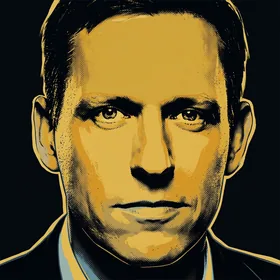
Ray Dalio vs. Peter Thiel: Learning From Patterns vs. Creating Something New


Here’s a question that divides two of the sharpest minds in business: Should you study what’s worked before and systematize it, or should you reject the past and build something entirely original? Ray Dalio built the world’s largest hedge fund by turning every experience into a repeatable principle. Peter Thiel co-founded PayPal and became Silicon Valley’s most contrarian investor by arguing that true value comes only from doing what’s never been done. Same goal — extraordinary success — radically different playbooks.
Ray Dalio: Solve the Puzzle, Collect the Gem
“I have found it helpful to think of my life as if it were a game in which each problem I face is a puzzle I need to solve. By solving the puzzle, I get a gem in the form of a principle that helps me avoid the same sort of problem in the future. Collecting these gems continually improves my decision making, so I am able to ascend to higher and higher levels of play in which the game gets harder and the stakes become ever greater.”
— Ray Dalio, Principles: Life and Work
Dalio’s entire worldview rests on the idea that reality follows patterns, and the smartest thing you can do is recognize them. He started Bridgewater Associates out of a two-bedroom apartment and grew it into what Fortune assessed as the fifth most important private company in the U.S. — not through a single flash of genius, but through decades of relentless pattern recognition. Every mistake, every market blow-up, every personnel conflict became raw material for a new principle. Over time, those principles compounded into a decision-making system so robust that CIO magazine called him “the Steve Jobs of investing.”
The method is almost scientific. Encounter a problem. Diagnose it. Extract a rule. Write it down. Apply it next time “another one of those” shows up. Dalio organized his principles into layered outlines — higher-level, mid-level, sub-principles — because he believes the world is legible if you’re disciplined enough to read it. His culture at Bridgewater, built on “radical truth, radical transparency, and believability-weighted decision making,” is essentially a machine for converting past experience into future advantage. The past isn’t a prison; it’s a goldmine. You just have to mine it systematically.
Peter Thiel: Stop Copying, Start Creating
“Every moment in business happens only once. The next Bill Gates will not build an operating system. The next Larry Page or Sergey Brin won’t make a search engine. And the next Mark Zuckerberg won’t create a social network. If you are copying these guys, you aren’t learning from them.”
— Peter Thiel, Zero to One
Thiel’s opening salvo in Zero to One is a direct challenge to anyone who thinks success comes from studying and replicating what worked before. His core argument is that the most valuable companies don’t iterate — they invent. Going from 1 to n (copying an existing model) is incremental. Going from 0 to 1 (creating something genuinely new) is where transformative value lives. And you can’t get there by following a template, no matter how well-organized that template is.
Thiel is deeply skeptical of what he calls “indefinite” thinking — the tendency to hedge, diversify, and optimize within known frameworks rather than commit to a bold, concrete vision of the future. As he puts it: “Process trumps substance: when people lack concrete plans to carry out, they use formal rules to assemble a portfolio of various options.” For Thiel, the greatest risk isn’t making a wrong bet — it’s never making a singular bet at all. PayPal didn’t emerge from a principle library. It emerged from a conviction that digital payments would reshape commerce, pursued with the kind of focused intensity that no checklist can produce. The lesson of the greats isn’t their specific playbook; it’s that they had the audacity to write a new one.
The Tension
On the surface, these two approaches look irreconcilable. Dalio says: study reality, extract patterns, build systems. Thiel says: reject established patterns, imagine what doesn’t exist yet, and go build it. But the contradiction dissolves somewhat when you look at context. Dalio operates in financial markets — a domain where cycles repeat, human psychology is remarkably consistent, and pattern recognition is a genuine edge. Thiel operates in technology startups — a domain where the winners are, almost by definition, the ones doing something no one has done before. The nature of the game shapes which philosophy wins.
There’s also a subtler compatibility at play. Dalio doesn’t advocate blindly following anyone’s principles — including his own. He explicitly says: “Don’t want you to follow my (or anyone’s) principles blindly. I suggest that you think through all the principles available to you from different sources and put together a collection of your own.” That’s not pure pattern-following; it’s a call to synthesize and think independently. And Thiel, for all his contrarianism, isn’t saying history is useless. He’s saying the lesson of history’s greatest entrepreneurs is to think originally — which is itself a principle derived from studying what worked. Both men agree on one thing: conventional wisdom, followed conventionally, produces conventional results.
The Memo
-
Match your method to your domain. In environments where patterns repeat — markets, operations, management — systematize your learning the way Dalio does. In environments where novelty is the whole point — new products, new markets, new technology — lean toward Thiel’s insistence on original thinking. Know which game you’re playing.
-
Extract principles, but hold them loosely. Dalio’s system works because it’s alive — constantly updated with new “gems” from new encounters with reality. Principles become dangerous when they calcify into dogma. Build your library, but never stop questioning it.
-
Refuse to mistake process for progress. Thiel’s sharpest warning is that assembling portfolios of options can feel like strategy while actually being an avoidance of commitment. Systems and principles are tools, not substitutes for conviction. At some point, you have to make the singular bet.
-
Study the greats for the meta-lesson, not the playbook. Dalio and Thiel both arrive at the same deeper truth from opposite directions: the people who win don’t copy — they think for themselves. Whether you do that by building a principle system or by imagining what’s never existed, the underlying demand is the same: do your own thinking, rigorously and honestly.