Ref. 55 · Founder Stories · Power reserve 2 min
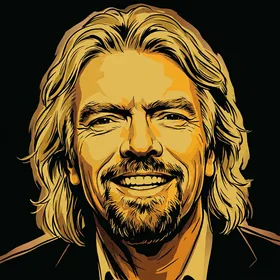
Richard Branson’s Razor-Thin Line Between Empire and Ruin

Before the private islands, the space company, and the eight billion-dollar ventures — there was a teenager with no money, no safety net, and no margin for error.
“For anyone who starts without financial backing there is a very thin line between success and failure.”
— Richard Branson, Losing My Virginity
Branson wrote this line while reflecting on the arc of his career after two pivotal events: the sale of Virgin Music and the legal victory over British Airways in 1993. Those moments marked the first time he felt he had “climbed the wall and could at last peer into the promised land.” But the wall itself — decades of bootstrapping, cash crunches, and existential risk — was the real story. Virgin started as a mail-order record retailer in 1970, launched by a twenty-year-old with no family fortune and no venture capital. Every step forward was funded by the last thing that worked, and every misstep threatened to end the entire enterprise.
What makes this observation powerful is its honesty. Survivor bias dominates entrepreneurial storytelling. We hear about the eight billion-dollar companies Branson built across eight different sectors. We rarely hear about the countless moments where the whole thing nearly collapsed. Branson isn’t being modest here — he’s being precise. When you start without capital, the distance between a breakthrough and a bankruptcy filing is measured in weeks, sometimes days. There is no cushion. Every decision carries disproportionate weight because there’s nothing to absorb the impact of a wrong one.
This is also why Branson’s famous “Screw it, let’s do it” philosophy is more nuanced than it appears on the surface. He didn’t leap blindly — he leaped knowing that the line was thin, and that awareness made him resourceful rather than reckless. He found legal ways around rules. He sold one business to fund the next. He treated constraints not as reasons to quit but as problems to solve with whatever was at hand. The thin line didn’t paralyze him; it sharpened him.
The Memo
-
Respect the thin line. If you’re building without a financial cushion, acknowledge the fragility of your position — not to scare yourself into inaction, but to make every decision with the seriousness it deserves.
-
Let constraints sharpen your thinking. Limited capital forces creativity. Branson didn’t wait for perfect conditions; he used each win to fund the next move. Treat resourcefulness as a competitive advantage, not a disadvantage.
-
Don’t confuse surviving with arriving. Branson built for over two decades before he felt he could see the promised land. If you’re still on the tightrope, that’s not failure — that’s the job.
Correction, 30 September 2026: an earlier version quoted this passage in altered wording. It now matches the book word for word.