Ref. 157 · deep dives · Power reserve 13 min
How 4 Billionaires Make Decisions When Nobody Knows What Happens Next


Every significant business decision is made in the dark to some degree. The market could turn, a competitor could move, a product could fail — and no amount of data fully eliminates that fog. What separates the billionaires from the rest isn’t that they found a way to see through the uncertainty. It’s that they developed rigorous, often hard-won frameworks for acting decisively within it.
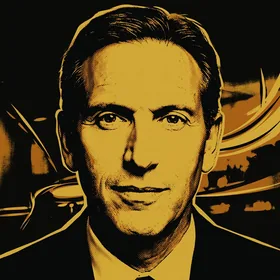
Howard Schultz, Ray Kroc, Richard Branson, and Mark Cuban built their empires across wildly different industries and eras. But thread their approaches to uncertainty together and a coherent — and sometimes contradictory — picture emerges of what it actually means to make great decisions when the outcome is unknowable.
The Illusion of Certainty: Why We’re Worse at This Than We Think
Before any useful decision-making framework can be applied, the first obstacle has to be cleared: our own confidence in our judgment. The source material around Schultz’s thinking draws on a blunt and important observation — that decisions are almost always made on the basis of a perception of reality, not reality itself.
“So many respected companies had fallen so far so fast, to the shock of so many. For the financial system and economy — as well as for Starbucks — it was taking a crisis to reveal fatal flaws.”
— Howard Schultz, Onward, ch. No Silver Bullets
This is a more unsettling point than it first appears. It isn’t just that we sometimes get things wrong — it’s that even our successes may be built on faulty reasoning. We attribute outcomes to our skill when luck was the dominant factor. We build playbooks from wins that were actually flukes. The confirmation bias runs so deep that good results actively reinforce bad mental models.
The investing world has grappled with this longer than most. The broader source material references Howard Marks — described aptly as a “philosopher-king of finance” — whose framework for navigating uncertainty rests on two foundations that most action-oriented entrepreneurs find deeply uncomfortable:
“In a world where nothing is stable or dependable and almost anything can happen, the first [step is]: Be Lucky. Second, Be Humble.”
— Referenced in Richer, Wiser, Happier
“Be lucky” sounds like a throwaway line. It isn’t. Acknowledging luck’s role isn’t fatalism — it’s intellectual honesty about the limits of your own causal reasoning. Branson, for his part, never pretended his path was purely the product of brilliant calculation. His autobiography frames the Virgin story as much about “endurance and survival” as about runaway success — a candid admission that the ride included as much chaos as control.
Mark Cuban takes a more street-level version of the same idea. His entire business philosophy rests on relentless preparation — because in a world where outcomes can’t be predicted, the quality of your inputs is the only variable you can reliably control. Relying on a “maybe I’ll get lucky” approach, as the material around his work notes, is simply not a viable strategy when “the environment is changing too quickly, margins are too tight, and the competition is too fierce.”
Slow Down to Speed Up: The Case Against Reflexive Action
One of the most consistent threads across all four billionaires’ approaches is a counterintuitive one: when uncertainty is highest, the instinct to act fast is most dangerous.
The source material around Schultz’s decision-making process highlights the cognitive trap of letting automatic thinking take over in high-stakes situations. While fast, instinctual decision-making works well for routine choices — the example given is driving a car — it breaks down under genuine complexity. Daniel Kahneman’s framework, referenced in the surrounding material, makes the mechanics explicit: our fast-thinking system is accurate much of the time, but it’s precisely when we’re most confident that our cognitive biases are most likely to lead us off a cliff.
The fix isn’t to think slower about everything. It’s to recognize which situations demand a gear change. The material connected to this theme puts it directly:
“I don’t think in that “grand design” pattern. I work from the part to the whole, and I don’t move on to the large scale ideas until I have perfected the small details.”
— Referenced source material, Grinding It Out context
The phrase “a feast for defaults” deserves to sit with you for a moment. Defaults are the decisions you make without realizing you’re making them — the habitual responses, the pattern-matched solutions, the answers that feel obvious. In uncertain environments, defaulting to what worked before is exactly how you get blindsided by what’s different now.
Branson’s biography and leadership writing reveal a man who processed decisions through listening rather than analysis paralysis. His entire leadership philosophy — developed over forty years without, by his own admission, ever reading a leadership book — centers on gathering real information from real people before acting. The instinct to project confidence and move fast is understandable. But Branson’s track record across hundreds of ventures suggests that the discipline of genuine listening — creating space between stimulus and response — is what allowed him to move boldly when it counted.
Ray Kroc’s framework, distilled from his decades building McDonald’s, adds an important philosophical dimension to this. For Kroc, the quality of your decisions was upstream of the decision itself — it was determined by the quality of your underlying philosophy and the knowledge you’d accumulated before the moment of choice arrived:
“But perfection is very difficult to achieve, and perfection was what I wanted in McDonald’s. Everything else was secondary for me.”
— Ray Kroc, Grinding It Out
This reframes the entire problem. The decision under pressure isn’t where the real work happens. The real work happens in the months and years of learning, building mental models, and stress-testing assumptions that precede it. By the time Kroc sat down to decide whether to acquire McDonald’s outright, he had spent years obsessively studying the system. The decision looked bold from the outside. From the inside, it was the logical endpoint of an enormous body of accumulated knowledge.
Clarify the Problem Before You Solve It
A recurring failure mode in uncertain environments isn’t bad judgment — it’s misdirected judgment. Smart people solving the wrong problem with great precision.
The fix is structural: before generating solutions, you need to be ruthlessly precise about what kind of problem you’re actually facing. Are you diagnosing a cause? Anticipating a future state? Choosing between options? These are fundamentally different cognitive tasks, and conflating them produces exactly the circular, energy-draining meetings that plague organizations under stress.
Mark Cuban’s approach to this is characteristically direct. He frames business decision-making not as an art but as a diagnostic discipline — one that requires knowing what to measure, what the measurements mean, and what to do about what you find. The analogy he uses is medical: “what a blood test, MRI, X-ray, and CT scan do for a medical doctor.” A doctor who skips the diagnostic step and goes straight to treatment isn’t being bold. They’re being reckless. Cuban applies the same logic to business decisions: clarity about the actual condition precedes any sensible prescription.
This is also where Branson diverges from the others in an interesting way. Where Kroc, Schultz, and Cuban all emphasize structured information-gathering before action, Branson’s public persona — and to a significant degree his actual practice — has always leaned toward action-first instinct. “Screw it, let’s do it” is not a diagnostic framework. It’s a bias toward motion. And it has produced both Virgin’s greatest triumphs and some of its most spectacular failures, including the Coca-Cola challenge he openly acknowledges losing. The lesson isn’t that Branson’s approach is wrong — it’s that it carries a specific risk profile that he managed through diversification and resilience rather than analytical rigor.
Where Billionaires Diverge: Risk Tolerance as a Personal Variable
The most revealing disagreement across these four figures isn’t about process — it’s about disposition. Specifically, how much uncertainty they were willing to absorb as the price of action.
Kroc’s philosophy, despite its entrepreneurial boldness, was grounded in a conservative epistemology: gather more knowledge, refine your philosophy, ensure your mental scales are properly calibrated before you act. He spent years in the franchise industry watching others before making his defining move. His risk tolerance was high, but his information requirements were higher.
Cuban’s position is that preparation is the best — and essentially the only — legitimate hedge against uncertainty. You can’t control the market, but you can control how thoroughly you’ve studied it. Cuban is famous for having read every contract, every term sheet, every competitor’s filing. His version of managing uncertainty is to systematically reduce the surface area of his own ignorance.
Branson operates from a different set of priors entirely. His framework tolerates — arguably welcomes — a level of informational incompleteness that would paralyze the others. His balloon flights are not a metaphor for his business philosophy; they are an expression of it. He bets on his ability to adapt mid-flight more than on the accuracy of his pre-flight calculations. This isn’t recklessness — it’s a different theory of where value creation lives. Branson believes more opportunity is lost to excessive caution than to bold action.
The broader source material’s reference to the 80/20 principle in uncertain environments offers a useful frame for reconciling these positions:
“Note here that it is not all uncertainty. In some situations you may have a concentration, of the 80/20 type, with very predictable and tractable properties, which enables clear decision making, because you can identify beforehand where the meaningful 20 percent are. These situations are very easy to control.”
— Referenced in source material
The implication is that uncertainty is not uniformly distributed. Some domains have pockets of predictability — identifiable concentrations where the outcomes are more tractable. The billionaires who thrive in uncertainty are, in part, the ones who’ve developed the skill of distinguishing between genuine unknowability and complexity that merely looks unknowable. Kroc identified that the fast-food franchise model had tractable, repeatable properties. Cuban identified that the early internet had an identifiable set of rules, even when most people thought it was pure chaos. Schultz identified that emotional connection to a product was a more stable variable than any particular economic cycle.
The Philosophy Upstream of Every Decision
Perhaps the deepest point of agreement across all four figures — and the one most consistently underappreciated — is that decision-making under uncertainty is not primarily a tactical skill. It’s a philosophical one.
Kroc is the most explicit about this. His entire framework rests on the premise that your decisions are only as good as the philosophy underlying them. A bad philosophy produces bad decisions even when the process is technically sound. A sound philosophy produces good decisions even in turbulent conditions — because it provides a stable reference point when external data is noisy or absent.
Schultz built Starbucks on a philosophy about what the product actually was — not coffee, but a third place, an emotional experience — and that philosophical clarity guided decisions through multiple near-death experiences, including a period when Schultz returned to the company after years away to find it had drifted from its foundational identity. The strategic recovery wasn’t primarily about better data or better process. It was about returning to a clear articulation of what the company was for.
Branson’s philosophy — that business should be fun, that people matter more than process, that the brand is ultimately about trust — has been a consistent north star across ventures as different as airlines, mobile phones, space travel, and health care. The diversity of Virgin’s portfolio is only coherent if you understand that it’s organized around a philosophy, not an industry thesis.
Cuban’s philosophy is perhaps the most mercantile of the four, but it’s no less clear: preparation wins. Outwork, outstudy, out-prepare. When you walk into an uncertain situation having done more homework than anyone else in the room, you’ve tilted the odds. Not eliminated the uncertainty — tilted the odds. That’s the most you can honestly claim to do.
Synthesis
Taken together, these four billionaires reveal a meta-pattern that runs counter to how decision-making is typically taught. The conventional model treats uncertainty as a problem to be solved — through more data, better models, smarter analysis. What Schultz, Kroc, Branson, and Cuban demonstrate, each in their own way, is that uncertainty is not a problem. It’s a condition. The relevant question isn’t how to eliminate it but how to build the philosophical and cognitive infrastructure to act well within it.
Where they disagree — on risk tolerance, on the role of instinct versus analysis, on how much process to insert before acting — those disagreements are instructive rather than confusing. They reflect genuine differences in domain, personality, and theory of competitive advantage. There is no single correct approach. But there are correct orientations: toward humility about your own assumptions, toward clarity about the actual problem before you attempt to solve it, toward a philosophy stable enough to navigate by when the data runs out. The billionaires who got this right didn’t all use the same map. But they all knew, with unusual precision, where they were trying to go.
The Memo
-
Interrogate your certainty before you act. If you feel absolutely sure about a high-stakes decision, treat that feeling as a warning sign, not a green light. False assumptions produce bad decisions even when the process looks clean.
-
Distinguish the type of problem before generating solutions. Are you diagnosing a cause, projecting a future state, or choosing between options? These require different cognitive approaches, and mixing them produces circular, unproductive deliberation.
-
Build your decision-making infrastructure before the pressure arrives. The quality of your choices under uncertainty is determined by the quality of your preparation — your knowledge, your philosophy, your mental models — accumulated long before the decision point.
-
Slow down exactly enough to identify your defaults. Fast-paced environments amplify habitual responses. Create just enough space between problem and solution to ask: am I solving this problem, or the last problem?
-
Locate the tractable 20 percent inside the uncertainty. Not every variable in a complex situation is genuinely unknowable. Find the concentrations of predictability and anchor your decisions there while remaining flexible about the rest.
-
Audit your philosophy, not just your process. Your decisions will only ever be as sound as the underlying beliefs about value, purpose, and competitive advantage that generate them. When decisions feel consistently off, the problem is usually upstream.
-
Accept luck’s role without surrendering agency. Acknowledging that chance shapes outcomes doesn’t mean abdicating responsibility for your decisions — it means calibrating your confidence appropriately and avoiding the trap of mistaking a lucky outcome for a replicable system.
Correction, 30 September 2026: an earlier version of this memo joined passages that are not adjacent in the book without marking the cut. The quote now shows it, or stops where the book’s passage does.