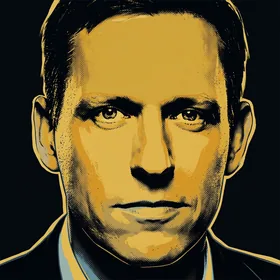
Ref. 156 · versus · Power reserve 5 min
Schwarzman vs. Thiel: Learning From Failure vs. Never Accepting It


What do you do when something goes wrong? One of the most consequential questions in business splits two of the sharpest financial minds of the modern era. Stephen Schwarzman, who built Blackstone into the world’s largest alternative asset manager, sees failure as an indispensable teacher. Peter Thiel, co-founder of PayPal and Palantir, is far more interested in building things so singular they never have to fail in the first place.
Stephen A. Schwarzman: Failure as the Ultimate Curriculum
“Failures, I want them to know, can teach us more than any success.”
— Stephen A. Schwarzman, What It Takes
Schwarzman’s philosophy is forged from decades of dealmaking, where not every bet lands and not every market cooperates. His willingness to sit with failure — to extract its lessons rather than bury its memory — defines how he’s built and rebuilt teams, strategies, and businesses over half a century. In What It Takes, he speaks directly to the next generation of leaders, stressing that resilience in the face of adversity is the actual measure of a person, not the adversity itself.
This is the worldview of someone who has operated in markets long enough to know that cycles turn, deals fall apart, and even the best-run organizations hit walls. For Schwarzman, the question is never whether you will fail — it’s whether you are paying close enough attention when you do. He built Schwarzman Scholars, his flagship educational legacy, in part to instill exactly this mindset: that setbacks are data, and data is what separates the people who compound success over time from those who don’t. The process of perseverance — imperfect, iterative, occasionally humbling — is the point.
Peter Thiel: Escape the Competition Entirely
“Every moment in business happens only once. The next Bill Gates will not build an operating system. The next Larry Page or Sergey Brin won’t make a search engine. And the next Mark Zuckerberg won’t create a social network. If you are copying these guys, you aren’t learning from them.”
— Peter Thiel, Zero to One
Thiel’s operating philosophy begins upstream of failure entirely. His central argument in Zero to One is that the best businesses don’t compete — they create something so new, so genuinely original, that competition becomes irrelevant. Going from 0 to 1 means building something the world has never seen before. Going from 1 to n — copying what already exists and doing it marginally better — is the path Thiel warns against most strenuously. In his framework, most failure isn’t instructive; it’s the predictable result of fighting in the wrong arena.
Where Schwarzman looks at failure as a teacher to respect, Thiel looks at it as a signal that you may be asking the wrong question altogether. If you’re losing in a competitive market, the lesson isn’t just to try harder — it’s to ask whether you should be in that market at all. Thiel’s solution is radical differentiation: build a monopoly through innovation, not a slightly better version of what someone else already built. “Unless they invest in the difficult task of creating new things,” he writes, “companies will fail in the future no matter how big their profits remain today.” The emphasis is on new — not better, not cheaper, not faster. New.
The Tension
These two approaches aren’t as incompatible as they first appear — but they operate at very different altitudes. Thiel is talking about the strategic level: what business to build, what market to enter, what problem to solve. His argument is that the smartest move is to choose a game you can win before you ever start playing. Schwarzman is talking about the operational and personal level: once you’re in the arena, what do you do when things go sideways? His answer — learn, adapt, persist — assumes you’re already in the fight. Thiel would ask whether you should have picked that fight to begin with.
The real insight is that both frameworks are necessary at different stages of a business life. Thiel’s lens is most valuable at the beginning, when you’re deciding where to place your bet. Schwarzman’s lens becomes essential once the bet is placed and reality starts pushing back. A founder who only thinks like Thiel may be too proud to learn from setbacks; one who only thinks like Schwarzman may grind heroically in a market that was never winnable. The leaders who last tend to hold both ideas at once: choose your arena with ruthless originality, then bring hard-won resilience to whatever comes next.
The Memo
-
Choose your arena before you commit to it. Thiel’s framework demands you ask whether you’re building something genuinely new — not just competing in a crowded space with marginally better execution. Do this work before you’re too invested to be honest.
-
Mine your failures for data, not just motivation. Schwarzman doesn’t romanticize setbacks — he systematizes them. When something goes wrong, the question isn’t “how do I feel about this?” It’s “what is this telling me that success never would?”
-
Resist the urge to copy what’s already working for someone else. Thiel’s warning is blunt: if you’re modeling your company on a proven success, you’re already behind. The next great company won’t look like the last one.
-
Treat resilience as a skill, not a personality trait. Schwarzman’s message to young leaders is that the ability to move through adversity is built through practice — through repeatedly choosing to dig down and move forward rather than retreat. That capacity compounds over time just like capital does.