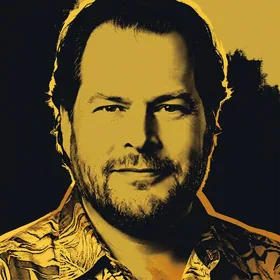
Ref. 200 · versus · Power reserve 5 min
Richard Branson vs. Marc Benioff: Leap First vs. Climb Smart


Should you throw yourself at a new venture the moment instinct says go — or should you map the terrain before you take a single step? Richard Branson and Marc Benioff have both built billion-dollar empires, but they arrived at starkly different answers to that question.
Richard Branson: Screw the Plan, Just Move
Branson has never been shy about his allergy to over-analysis. The philosophy that powered Virgin — across music, airlines, mobile, space, and dozens of ventures in between — is captured in a phrase so simple it became the title of his book.
“I will never say, ‘I can’t do this because I don’t know how to.’ I will give it a go. I won’t let silly rules stop me. I will find a legal way around them. I tell my staff, ‘If you want to do it, just do it.’”
— Richard Branson, Screw It, Let’s Do It
For Branson, hesitation is the real risk. He built Virgin Atlantic not because the numbers screamed opportunity, but because he was frustrated by the existing options and believed he could do better. There was no exhaustive feasibility study. There was a phone call to Boeing to ask about leasing a secondhand 747. The willingness to move before all the answers were in wasn’t recklessness — it was the engine.
He’s explicit about what happens when that impulse gets constrained. When Virgin briefly went public, Branson watched the culture curdle under the weight of shareholder expectations and formal process. As he reflects in the book, half of Virgin’s greatest successes — including the signing of Mike Oldfield’s Tubular Bells and the launch of Virgin Atlantic — were driven by “contrarian intuition or carpe diem moments, not on tortuous feasibility studies, business plans and financial projections.” Going public nearly suffocated what made Virgin, Virgin. He bought the company back. The lesson, to him, was clear: structured deliberation can kill the very thing you’re trying to protect.
Marc Benioff: Growth Put Before Trust
Benioff’s thinking, as laid out in Trailblazer, starts from a different premise entirely. Building Salesforce into the world’s leading CRM platform required not just bold vision but disciplined navigation — knowing when to push forward and when to deliberately slow down or even step back.
“Every CEO has to perform a delicate dance between two priorities: trust and growth. Intellectually, we all know that whenever growth is put before trust, a problem will eventually appear. It can happen to the best of leaders, and to the most respected of companies.”
— Marc Benioff, Trailblazer
Note the ordering he insists on. Benioff is not arguing that growth is dangerous; he is arguing that it is a claim drawn against trust, and that the bill arrives later. He reaches for Toyota’s recall crisis to make the point — a company that, in its own chairman’s words before Congress, pursued growth faster than it could develop the people and the organisation to carry it. This worldview shaped how Salesforce scaled: deliberately, with structures built to support growth before growth outran them.
Where Branson sees feasibility studies as obstacles to momentum, Benioff sees deliberate thinking as a competitive advantage. The discipline of slowing down — of asking what a given quarter of growth is being borrowed against — is what separates companies that grow fast and survive from those that grow fast and collapse under their own speed. For Benioff, integrity and structure aren’t bureaucratic constraints. They’re the load-bearing walls of a lasting business.
The Tension
Here’s what makes this contrast genuinely interesting: both men are right, and the source material makes that uncomfortable to ignore. Branson’s “just do it” ethos worked spectacularly in industries ripe for disruption, where speed and audacity were the actual product differentiators — where being first and being bold mattered more than being perfect. Virgin Atlantic succeeded in part because it was launched before conventional analysis could talk anyone out of it. In creative, consumer-facing, or contrarian bets, overthinking is a genuine killer.
But Benioff was building enterprise software at scale — a domain where trust, reliability, and structured growth aren’t optional extras. A company selling to Fortune 500 procurement teams cannot run on vibes and momentum alone. The clients Salesforce needed demanded predictability. Putting trust ahead of growth wasn’t a personality preference; it was a product requirement. The lesson isn’t that one man is bolder or smarter than the other. It’s that the right approach depends on what failure costs you — a cancelled Virgin venture loses money, a breach of enterprise trust loses the franchise.
The Memo
-
Match your decision speed to your industry’s tolerance for error. In fast-moving, consumer-facing markets, Branson’s bias for action beats analysis paralysis. In high-stakes, trust-dependent markets, Benioff’s deliberate pacing protects the foundation you’re building on.
-
Protect the conditions that make your best decisions possible. Branson bought Virgin back from public markets to reclaim the freedom that made it work. Know what environment your judgment needs — and defend it.
-
Know what your growth is borrowed against. Benioff’s claim is that growth taken ahead of trust is debt, not progress, and that it comes due at the worst moment. Before celebrating a growth number, name the thing it was funded by.
-
Audit which decisions you’ve been deferring. Branson’s challenge is direct: make the list, then make the calls. Delayed decisions compound into a drag on everything else. The act of deciding — even imperfectly — creates forward motion that overthinking never will.