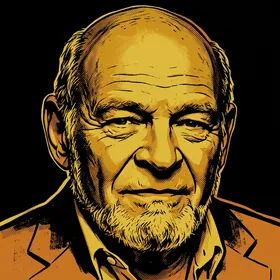
Ref. 37 · versus · Power reserve 5 min
Sam Zell vs. Stephen Schwarzman: The Rebel vs. The Institution Builder


Two of the most successful dealmakers in modern finance built empires worth tens of billions of dollars — yet they approached the game from fundamentally different postures. Sam Zell, the self-described “Grave Dancer” who thrived on contrarian bets and blunt force authenticity, and Stephen Schwarzman, the meticulous architect of Blackstone, the world’s largest alternative asset manager. The question at the heart of their divergence: do you build lasting wealth by staying scrappy, impatient, and iconoclastic — or by constructing systems, cultivating institutions, and pursuing excellence through process?
Sam Zell: The Restless Contrarian
“I can seem gruff. I know that. And I can be impatient. I have an embedded sense of urgency. What I can’t figure out is why so many other people don’t have it.”
— Sam Zell, Am I Being Too Subtle
Zell didn’t just tolerate being an outsider — he built his entire identity around it. From the opening pages of his memoir, he makes clear that he was “willing to trade conformity for authenticity — even when that meant being an outlier, which it usually did, and even if it meant being on my own.” This wasn’t posturing. It was a strategic orientation. Zell believed that the crowd was almost always wrong, that bureaucracy killed speed, and that the best deals were found where other people refused to look.
His career bears this out. Zell made his fortune buying distressed assets — real estate, companies, entire industries that others had left for dead. He didn’t build a massive institutional brand with thousands of employees and a global fundraising machine. He built a relatively lean operation powered by conviction, speed, and an almost allergic reaction to consensus thinking. His approach to business communication was the same: no filters, no corporate speak, no patience for people who couldn’t keep up. He handed out a “little red book” of his favorite sayings as a business card. The man wasn’t interested in polish. He was interested in being right, being fast, and being honest about both.
For Zell, urgency wasn’t just a personality trait — it was a competitive advantage. While institutional players were running deals through committees and building consensus, Zell was already at the closing table. He believed that in business, as in life, the window of opportunity doesn’t wait for you to finish your PowerPoint deck.
Stephen Schwarzman: The Architect of Scale
“Lessons in the Pursuit of Excellence.”
— Stephen A. Schwarzman, What It Takes (subtitle)
The very subtitle of Schwarzman’s book tells you everything about his philosophy. Where Zell embraced the chaos of being a lone wolf, Schwarzman dedicated his career to building something that would outlast any single deal — or any single person. Blackstone didn’t become the world’s dominant alternative asset manager by accident. It became one through deliberate, systematic institution-building: recruiting the best talent, creating repeatable investment processes, establishing a culture of rigorous analysis, and scaling that culture across asset classes and geographies.
Schwarzman’s approach required patience — the opposite of Zell’s embedded urgency. Building Blackstone from a two-person startup in 1985 into a firm managing hundreds of billions of dollars meant saying no to shortcuts. It meant building relationships with institutional investors over years, not weeks. It meant creating governance structures and risk management frameworks that could withstand market cycles. Schwarzman’s pursuit of excellence was not about the thrill of the contrarian bet. It was about constructing a machine that could identify, execute, and manage investments at a scale that no individual operator could match.
Where Zell’s business card was a booklet of irreverent one-liners, Schwarzman’s calling card was the Blackstone brand itself — a name synonymous with institutional credibility, blue-chip partnerships, and disciplined capital deployment. His philosophy wasn’t about being the smartest person in the room on any given deal. It was about building the room itself, and making sure it was filled with the smartest people, the best data, and the most rigorous processes.
The Tension
Here’s what makes this contrast genuinely instructive rather than just entertaining: both approaches produced extraordinary wealth, and both carry real risks. Zell’s model — lean, fast, conviction-driven — works brilliantly when you have a singular mind capable of seeing what others miss. But it’s fragile. It depends on the founder’s judgment, energy, and willingness to keep showing up. It doesn’t scale easily, and it doesn’t transfer well. The moment the contrarian genius steps away, the edge can evaporate.
Schwarzman’s model — institutional, process-driven, built for permanence — works brilliantly when the goal is durability and scale. But institutions can calcify. Process can become bureaucracy. The pursuit of excellence can quietly become the pursuit of consensus, which is the very thing Zell would argue kills great dealmaking. The larger the institution, the harder it is to move fast, to be contrarian, to make the uncomfortable bet that everyone else is running from.
The deeper insight is that these two approaches reflect different answers to a fundamental question every entrepreneur and investor must face: are you building around yourself, or are you building something that transcends yourself? Zell chose the former and thrived on it. Schwarzman chose the latter and built a legacy that will outlive him. Neither is wrong. But the choice shapes everything — the deals you pursue, the people you hire, the risks you take, and the kind of wealth you ultimately create.
The Memo
-
Know which game you’re playing. If your edge is personal conviction and speed, don’t bury it under institutional process. If your edge is systematic rigor and scale, don’t pretend you’re a gunslinger. Match your structure to your actual competitive advantage.
-
Treat urgency as a strategic asset, not just a personality trait. Zell’s impatience wasn’t a flaw — it was a moat. In markets where speed matters, the ability to decide and act while others deliberate is worth more than any spreadsheet.
-
Build systems that survive your absence. Schwarzman’s greatest achievement isn’t any single deal — it’s the fact that Blackstone’s machine keeps producing without him at every lever. If your business can’t function without you in every meeting, you haven’t built a business. You’ve built a job.
-
Trade conformity for authenticity — but know the cost. Zell was willing to be on his own. That’s powerful, but it’s lonely, and it limits how large you can grow. Decide early whether you want to be the outsider who wins big or the institution builder who wins long.