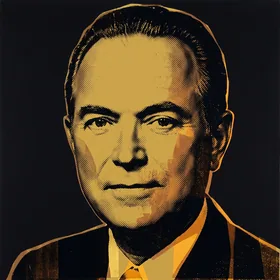
Ray Kroc was fifty-two, selling milkshake machines, when he drove to San Bernardino to see why one restaurant needed eight of them. The book is his account of what followed, and its argument is about time rather than insight.
The line the book exists to make
“People have marveled at the fact that I didn’t start McDonald’s until I was fifty-two years old, and then I became a success overnight. But I was just like a lot of show business personalities who work away quietly at their craft for years, and then, suddenly, they get the right break and make it big. I was an overnight success all right, but thirty years is a long, long night.”
— Ray Kroc, Grinding It Out
How he actually worked
Kroc is explicit that he had no grand design, and that this was deliberate:
“I don’t think in that ‘grand design’ pattern. I work from the part to the whole, and I don’t move on to the large scale ideas until I have perfected the small details.”
— Ray Kroc, Grinding It Out
The obsession that follows is not metaphorical. He describes rage at an unlit sign and litter in a car park:
“But perfection is very difficult to achieve, and perfection was what I wanted in McDonald’s. Everything else was secondary for me.”
— Ray Kroc, Grinding It Out
He also quotes, as his favourite, a homily on persistence — “Nothing in the world can take the place of persistence… Persistence and determination alone are omnipotent” — which is worth flagging because it is very often reproduced as Kroc’s own writing. It is not; he introduces it as a homily he keeps.
Where to be sceptical
The preface is not by Kroc. Grinding It Out opens with an introduction by a business-school professor, and lines from it — including the description of Kroc’s “great opportunity” arriving at fifty-two — circulate widely as Kroc’s own words. They are not. This archive made that mistake before correcting it.
The brothers’ account differs. Kroc’s version of acquiring the McDonald’s name and the handshake over the San Bernardino restaurant is contested by Dick and Mac McDonald’s side of the story. Kroc’s book is the only one of the two that became a bestseller, which is itself a lesson about whose account survives.