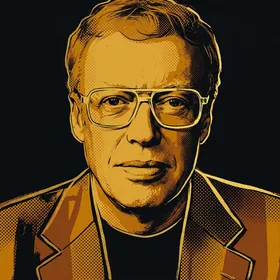
Ref. 75 · Single Quotes · Power reserve 2 min
Phil Knight Didn’t Plan to Build Nike — He Just Didn’t Plan Too Far Ahead
Most founders claim they saw the future clearly. Phil Knight admits he barely saw past the next step — and thinks that’s exactly why Nike exists.
“I feel sorry for the people who know exactly what they’re going to do from the time they’re sophomores in high school.”
— Phil Knight, Shoe Dog
When Knight was asked in 2016 about the long-term vision behind Nike, he gave an answer that surprised people expecting a grand origin myth. He wanted to be a professional athlete. He wasn’t good enough. So he looked for the next closest thing — some way, any way, to stay inside the world of sports. That pivot led him to run track under Bill Bowerman, a college coach obsessed with shaving weight off running shoes. Bowerman became his cofounder. The rest followed from there, one short step at a time.
Knight wasn’t being falsely modest. In Shoe Dog, he’s candid about the hundreds — maybe thousands — of bad decisions he made along the way. Wrong bets on athletes. Layoffs that still haunt him. Time not spent with his sons. Nike wasn’t built on a master plan. It was built on relentless forward motion and a willingness to course-correct when the road curved. What looked like vision from a distance was, up close, just someone who refused to stop moving.
There’s a reason this cuts against everything taught in business schools. We prize the ten-year roadmap, the pitch deck with hockey-stick projections, the founder who “always knew.” But rigid long-term planning can be its own trap — it locks you into a version of yourself and your market that may no longer exist by the time you get there. Knight’s short-term orientation kept him adaptive. When the first Nike shoes fell apart on Notre Dame’s field, he didn’t abandon the company — he found better factories. When an athlete chose a competitor’s shoe, he used that gut-punch to fuel the next move. The horizon was always close enough to see clearly.
The lesson isn’t to abandon ambition or drift without purpose. It’s that the most durable companies are often built by people who stayed curious about what came next rather than committed to what they’d already decided. Knight had a compass — stay close to sport, stay close to athletes — but he held his maps loosely.
The Memo
-
Define your compass, not your destination. Know the domain you care about deeply. Let the specific path reveal itself as you move.
-
Plan in sprints, not decades. Ask what the best next move is right now — not what the best move will be in five years in a market you can’t fully see.
-
Resist the pressure to perform certainty. Founders who admit they figured it out step-by-step aren’t confessing weakness — they’re describing how most great companies actually get built.