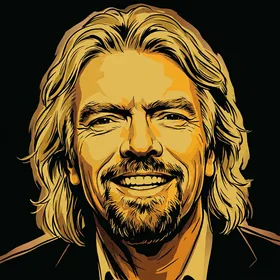
Ref. 62 · Single Quotes · Power reserve 3 min
Richard Branson’s Two-Word Philosophy That Built an Empire: Just Do It

Before Nike made it a slogan, Richard Branson was already living it. In his book Screw It, Let’s Do It, Branson distills a lifetime of building over 400 companies into a principle so simple it almost sounds naive — until you realize how few people actually follow it.
“The best lesson I learned was to just do it. It doesn’t matter what it is, or how hard it might seem, as the ancient Greek, Plato, said, ‘The beginning is the most important part of any work.’ A journey of a thousand miles starts with that first step. If you look ahead to the end, and all the weary miles between, with all the dangers you might face, you might never take that first step. And whatever it is you want to achieve in life, if you don’t make the effort, you won’t reach your goal. So take that first step. There will be many challenges. You might get knocked back —”
— Richard Branson, Screw It, Let’s Do It
Branson writes this reflecting on how he got started in life. He was dyslexic, struggled in school, and had to teach himself to memorize things by heart — a limitation he turned into one of his sharpest business tools. He grew up in a time when career paths were more predictable, often inherited from your father. But even then, he recognized that certainty was an illusion. What mattered wasn’t the plan. What mattered was the motion.
He launched Student magazine at 16. He started Virgin Records out of a church basement. He launched an airline with no aviation experience. In every case, the pattern was the same: Branson didn’t wait until he had everything figured out. He took the first step, then solved problems as they appeared. The beginning — messy, uncertain, imperfect — was always the most important part.
This is where most people stall. They confuse preparation with progress. They study the full distance of the journey, catalog every risk, and convince themselves they need more information, more capital, more confidence before they can start. Branson’s insight — borrowed from Plato and pressure-tested across decades of entrepreneurship — is that the act of beginning creates its own momentum. You don’t need to see the whole staircase. You need to take the first step, and then the next one reveals itself.
What makes this more than motivational poster wisdom is the context of who’s saying it. This isn’t someone who got lucky once. Branson has started businesses in music, aviation, telecommunications, space travel, health, and finance. He’s been knocked back countless times — he’s been sued, nearly gone bankrupt, and literally almost died in hot air balloon crashes. Every time, the thing that got him through wasn’t a perfect strategy. It was the willingness to begin again.
The Memo
-
Start before you’re ready. The gap between “planning to do something” and “doing something” is where most ambitions go to die. Branson’s career is proof that imperfect action beats perfect preparation.
-
Shrink the horizon. Stop staring at the finish line. Focus only on the next step. The full journey will paralyze you; the next move won’t.
-
Treat setbacks as part of the sequence, not the end of it. Branson expects to get knocked back. The difference is he doesn’t interpret a knockback as a signal to stop — he interprets it as the cost of having started.