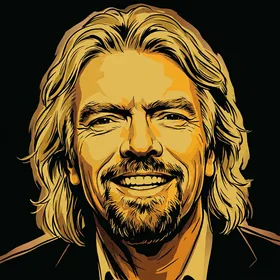
This is the book behind the phrase, and it is much shorter and more direct than Losing My Virginity. It opens with the line the whole Virgin persona rests on:
“The staff at Virgin have a name for me. It is ‘Dr Yes.’ They call me this because I won’t say no. I find more reasons to do things than not to do them. My motto really is: ‘Screw it - let’s do it.’”
— Richard Branson, Screw It, Let’s Do It, ch. Just Do It!
The passage that corrects the caricature
Branson is quoted endlessly as an advocate of leaping. In this book he says the opposite, plainly, in a scene where a game-show winner is deciding whether to gamble a million-dollar cheque on a coin toss:
“I could have told him, I take risks, but they are calculated risks. I weigh up the odds in everything I do.”
— Richard Branson, Screw It, Let’s Do It, ch. Be Bold
He makes the same point about the airline, which is the venture most often cited as evidence of his recklessness:
“I was bold, yes, but not foolish. I took a risk by starting up an airline. But the odds were good. They were not all or nothing … and I had thought through how to manage the risks.”
— Richard Branson, Screw It, Let’s Do It, ch. Be Bold
If you only read one Branson passage, read that one. It is the difference between the brand and the operator.
On barriers
His advice to people without the obvious credentials is the most practical thing in the book:
“I don’t believe that that little word ‘can’t’ should stop you. If you don’t have the right experience to reach your goal, look for another way in.”
— Richard Branson, Screw It, Let’s Do It, ch. Just Do It!
Where to be sceptical
It is a motivational book and makes no pretence otherwise — assertion, anecdote, very little evidence. Branson is also arguing from a position where the downside was always survivable, which is exactly the asymmetry his “calculated risk” framing depends on and does not examine. The advice is sound; the worked examples come from someone who could afford to be wrong.
Nine lessons, each a list of maxims
Screw It, Let’s Do It is short by design — it began life as a Quick Reads title — and it is organised as nine lessons rather than a narrative. Each lesson opens with its own contents list of maxims, then illustrates them with episodes from Branson’s life.
That structure is why the book reads as thinner than Losing My Virginity while covering some of the same ground: the stories are compressed into service of a maxim rather than told for themselves.
| Lesson | The maxims under it |
|---|---|
| 1 · Just Do It! | Believe it can be done · Have goals · Live life to the full · Never give up · Prepare well |
| 2 · Have Fun! | Have fun, work hard and money will come · Don’t waste time, grab your chances · Have a positive outlook |
| 3 · Be Bold | Calculate the risks and take them · Believe in yourself |
| 4 · Challenge Yourself | Aim high · Try new things · Always try |
| 5 · Stand On Your Own Feet | Rely on yourself · Chase your dreams but live in the real world · Work together |
| 6 · Live the Moment | Love life and live it to the full |
| 7 · Value Family and Friends | Put family and the team first · Be loyal · Face problems together |
| 8 · Have Respect | Be polite and respectful · Do the right thing · Keep your good name · Be fair in all your dealings |
| 9 · Do Some Good | Change the world, even if in a small way · Make a difference and help others |
The maxims are the book’s actual argument, and they are worth reading as a list: six of the nine lessons are about conduct toward other people rather than about business. For a book marketed on the strength of a serial entrepreneur’s risk appetite, that is a more interesting fact than anything in the risk chapters.
Note also that lesson 8’s “Keep your good name” is Branson at his most quotable and least tested — “Your reputation is everything” sits a few lines from his account of checking constantly that he is not breaking the law. Read them together rather than separately.