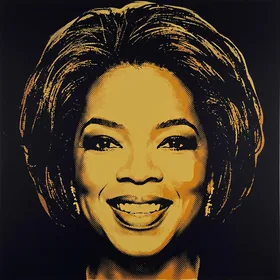
Every other book in this collection is written to explain how its author built something. What I Know for Sure is not. It is a set of short personal essays, collected from Winfrey’s monthly column in O, organised under headings like Joy, Resilience, Gratitude and Clarity.
That distinction matters more than it sounds, because it is the reason this book is the most misquoted in the archive.
The book has a genuinely good origin
It begins with a question Winfrey could not answer on live television in 1998:
“‘Tell me,’ he asked, ‘what do you know for sure?’ Now, this was not my first rodeo. I’ve asked and been asked an awful lot of questions over the years, and it isn’t often that I find myself at a complete loss for words — but I have to say, the man managed to stop me in my tracks.”
— Oprah Winfrey, What I Know for Sure
The critic was Gene Siskel. She stalled, promised to think about it, and then spent sixteen years answering it in print. The book is the accumulated answer, which is why it has no argument and no arc — it is a ledger of things she stopped doubting.
What it actually says
The recurring subject is attention: what you point it at, and what that costs you.
“What I know for sure is that how you spend your time defines who you are. … I’ve decided to keep only that which delights me or enhances my well-being.”
— Oprah Winfrey, What I Know for Sure, ch. Clarity
The most useful essay is on gratitude, and it is more practical than the topic suggests — she frames it as a tool for perspective rather than a mood:
“Being grateful all the time isn’t easy. But it’s when you feel least thankful that you are most in need of what gratitude can give you: perspective.”
— Oprah Winfrey, What I Know for Sure, ch. Gratitude
The passage arrives via Maya Angelou telling her to stop crying and say thank you, which is characteristic of the book: the insight is always attached to a specific person and a specific bad day.
Why this book gets misquoted more than any other here
Because it is short, personal and non-prescriptive, it is unusually easy to paraphrase into business maxims — and those paraphrases then circulate as quotations.
This archive did exactly that. A passage about “‘going long’ by pursuing growth and deciding to stay small” and “going medium” was attributed to this book across several memos. That vocabulary appears nowhere in it, and it is not language Winfrey uses anywhere. It was business-book prose wearing her name, and it survived because it sounded plausible in a memo about scaling.
The book’s own sentences are shorter, more concrete and less useful to a strategy deck — which is precisely why nobody invents them.
How to read it
Treat it as memoir and it is candid and specific, particularly on the years when her weight functioned as an apology to the world. Treat it as a business text and you will find yourself supplying the argument it declines to make.
Every chapter opens with someone else’s words
What I Know for Sure is an introduction and eight themed chapters, drawn from Winfrey’s monthly O column of the same name. The chapters are named with single abstract nouns, so the list tells you nothing — but there is a more important thing the list hides.
Each chapter opens with an epigraph by someone else. Quote the first line of a chapter here and you are quoting Masahide, Williamson, Eckhart, Wiesel, Epictetus or Angelou — not Winfrey.
| Chapter | Opens with | What is in it |
|---|---|---|
| Introduction | — | Where the column came from, and her admission that the answer still often does not come easily. |
| Joy | — | Tina Turner on the show, and wanting to run away as a backup dancer. |
| Resilience | ”Barn’s burnt down / Now I can see the moon.” — Mizuta Masahide | Her own beginning, an April afternoon in 1953 in rural Mississippi. |
| Connection | ”Love is the essential existential fact…” — Marianne Williamson | What thousands of interviews taught her about what people actually want. |
| Gratitude | ”If the only prayer you ever say… is ‘Thank you,’ it will be enough.” — Meister Eckhart | The decade-long gratitude journal, and the honest part: how it lapsed once she got busy. |
| Possibility | ”Soar, eat ether, see what has never been seen…” | Follows the numbered list of blessings that closes the previous chapter. |
| Awe | ”In the word question, there is a beautiful word — quest.” — Elie Wiesel | Why she stopped making New Year’s resolutions. |
| Clarity | ”First say to yourself what you would be…” — Epictetus | ”I was 40 years old before I learned to say no.” |
| Power | ”When you know better, you do better.” — Maya Angelou | Paul Simon’s Born at the Right Time, and being born in 1954. |
That last one is the trap in miniature. “When you know better, you do better” is very widely attributed to Winfrey, because it appears in her book and she has quoted it often. It is Maya Angelou’s, and this book prints it as an epigraph with Angelou’s name attached.
If you take one thing from this page: on this book, check whether a sentence sits above or below the epigraph rule before attributing it.